Business
Fintechzoom.com Explained: A Guide to Its Financial News, Markets, and Tools

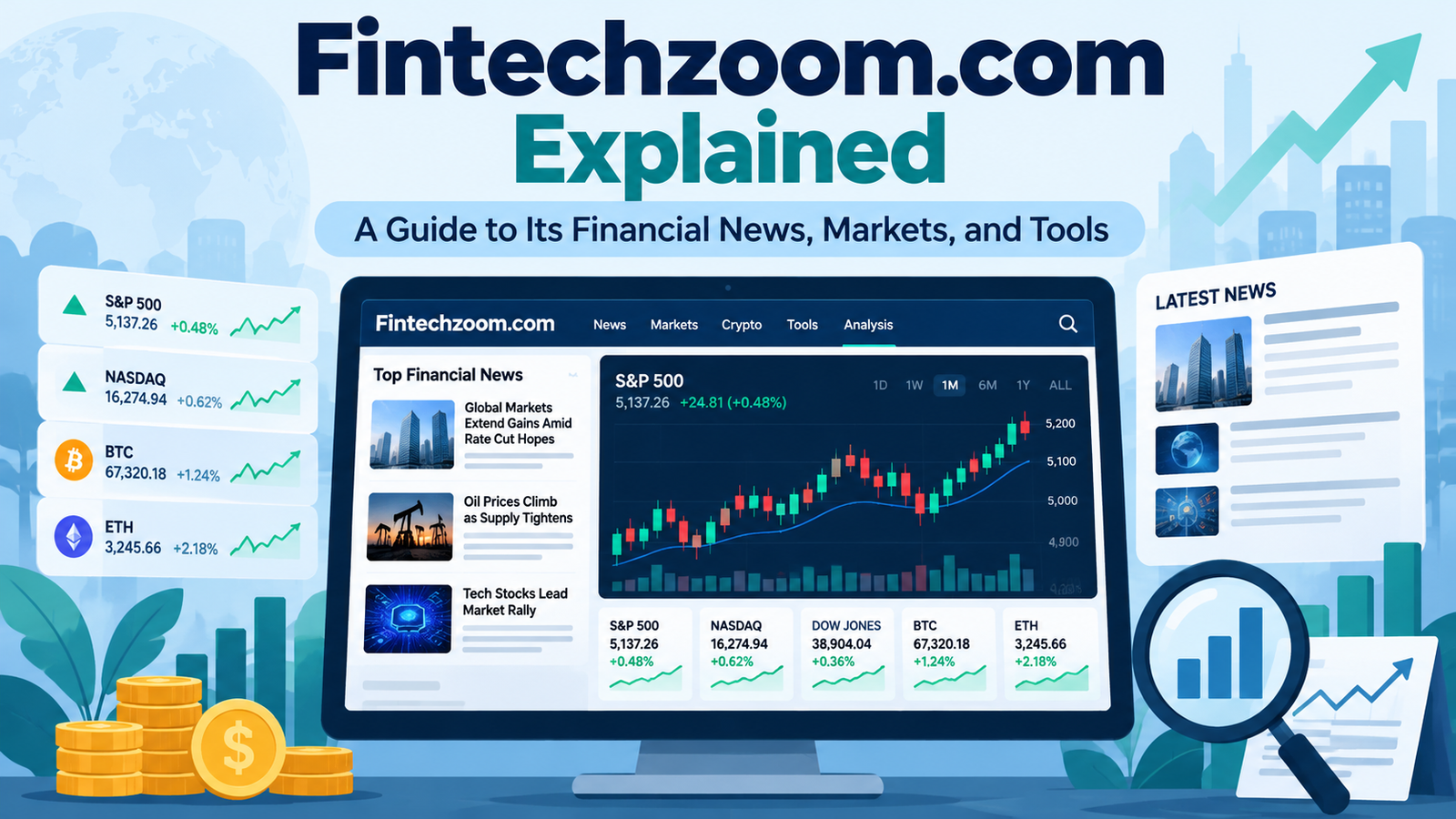
FintechZoom.com is a financial news and education website known for covering markets, business, and financial technology. Its reported subjects include stocks, cryptocurrencies, commodities, foreign exchange, bonds, banking, digital payments, personal finance, and economic developments. The site reportedly states that it has published financial content since 2016.
It is presented as a media and research resource, not a bank, broker, exchange, or regulated adviser. Ownership and premium-service details remain limited. Readers should distinguish it from FintechZoom.io, whose affiliation has not been confirmed.
1. What fintechzoom.com Covers
fintechzoom.com reportedly covers finance, markets, business, and fintech. Topics include stocks, cryptocurrency, banking, digital payments, bonds, foreign exchange, commodities, and real estate. It also covers businesses, economic news, financial rules, and changes in financial technology.
The reported sections include Markets, Business, Crypto, Money, Economy, Lifestyle, Finance, and Technology. The site is not limited to stock prices or trading news. Readers may find company news, budgeting guides, digital banking topics, and blockchain information.
The site also covers personal finance and wider economic topics. These may include interest rates, inflation, economic indicators, artificial intelligence, and cybersecurity in finance. The site reportedly began publishing financial content in 2016. Readers should check the date of each article because financial information can change quickly.
2. News, Analysis, Guides, and Market Data on fintechzoom.com
Financial websites often publish different types of content. News reports describe events, such as company announcements, economic data, or new rules. Market analysis explains why a price or market may have moved. It may also include opinions about what could happen next.
Educational guides explain basic ideas. These may include inflation, interest rates, bonds, exchange-traded funds, blockchain, crypto wallets, indexes, and foreign exchange. Such guides can help new readers learn common financial terms.
Some pages may show prices, charts, index levels, and market changes. These numbers may not update when the article does. Data may be delayed, incomplete, or updated at another time. Before using a number, check the asset, currency, unit, market, and time.
Readers should also separate facts from opinions and forecasts. A company filing is a fact. A writer’s view about that filing is analysis. A forecast is an estimate, not a promise. Ask, “Is this a fact, an explanation, or a prediction?”
3. fintechzoom.com Stock Market and Index Coverage
fintechzoom.com is described as covering major U.S. and global stock markets. Reported U.S. index coverage includes the Nasdaq Composite, Nasdaq-100, S&P 500, Dow Jones Industrial Average, and Russell 2000.
Each index tracks a different group of companies. The Nasdaq Composite covers many companies listed on Nasdaq and has many technology stocks. The Nasdaq-100 tracks 100 large non-financial companies listed on Nasdaq. The S&P 500 tracks 500 leading U.S. companies and is a broad market measure. The Dow tracks 30 major U.S. companies. The Russell 2000 focuses on smaller U.S. companies.
Reported global coverage includes the FTSE 100 in the United Kingdom, the Nikkei 225 in Japan, the STOXX Europe 600, the DAX 40 in Germany, the CAC 40 in France, and the Hang Seng in Hong Kong. Global markets trade at different times. A report from one region may cover a different part of the trading day than a report from another region.
Stock market pages may discuss prices, daily changes, opening and closing levels, highs and lows, trading volume, charts, earnings, revenue, profit, investor views, market breadth, and sector rotation. An index may rise even when many stocks fall. This can happen when a few large companies strongly affect the index.
4. Why Stock Prices Move
Stock prices can move when investors change their views about a company or the economy. Common factors include earnings, revenue, profit, and earnings per share. Investors may also watch new products, business results, competition, debt, and the value of a company’s shares.
Economic news also affects stock prices. Inflation, interest rates, jobs data, and economic growth can change how investors value stocks. Statements and decisions from the Federal Reserve may affect borrowing costs and the economy. Government policy, global events, trading activity, and investor confidence can also move prices.
A company may report strong results and still see its stock price fall. This can happen if investors expected even better results. If profit rises but falls below forecasts, some investors may sell. Readers should compare results with market expectations.
Sector rotation can also affect prices. Investors may move money from one industry to another. For example, they may sell technology stocks and buy stocks in another sector. One part of the market may rise while another falls.
5. fintechzoom.io Nasdaq Coverage Explained
“FintechZoom.io Nasdaq” means Nasdaq-related information published on fintechzoom.io. It is not the name of a stock, exchange, or investment product. Nasdaq is an exchange and a group of market indexes. The phrase refers to coverage on a separate website.
Reported content may include market news, stock information, charts, past performance, company updates, and technical analysis. It may also cover economic news that affects technology stocks. Reported technical tools include moving averages, the Relative Strength Index (RSI), MACD, support and resistance levels, trading volume, and sector heatmaps.
Some third-party descriptions mention watchlists, alerts, calculators, portfolio tracking, and artificial intelligence tools. Their availability has not been confirmed. The site has also not been clearly shown to be run by Nasdaq, a regulated broker, or a stock-trading platform with confirmed real-time data.
People who want to buy or sell Nasdaq-listed stocks usually need a separate regulated broker. A website chart or trading strategy does not prove that the site can place trades or hold customer assets.
6. Cryptocurrency and Blockchain on fintechzoom.com
Cryptocurrency and blockchain are major reported topics on fintechzoom.com. Coverage includes Bitcoin, Ethereum, stablecoins, altcoins, digital tokens, crypto exchange-traded funds, wallets, mining, decentralized finance, regulation, and digital-asset security.
A blockchain is a shared digital record that stores and checks transactions across a network. A crypto wallet helps users manage access to digital assets. Mining helps some blockchain networks check transactions and protect the network. Market capitalization is the total value of a cryptocurrency based on its price and available supply.
Ethereum is a blockchain used for smart contracts and decentralized apps. Bitcoin is a digital asset with its own blockchain. A Bitcoin halving cuts the reward paid to Bitcoin miners. The available information says a halving happens after every 210,000 blocks.
Crypto prices can change quickly. Prices may also differ between exchanges because of liquidity, currency pairs, and update times. A price on one page may not match a price on another page at the same moment.
Reported risks include price changes, new rules, fraud, custody problems, wallet security threats, low liquidity, and exchange risk. Institutional use, network updates, blockchain payments, and decentralized finance may affect interest in digital assets. Price forecasts are estimates and are not guaranteed.
7. Gold, Silver, Oil, and Other Commodities
fintechzoom.com reportedly covers many commodities. These include precious metals, energy products, industrial metals, and farm goods. Precious metals include gold, silver, and platinum. Energy topics include crude oil and natural gas.
Gold and other precious metals can be affected by inflation, interest rates, currency changes, investor demand, industrial demand, economic uncertainty, central-bank buying, and global events. Gold is often linked to wealth protection and economic uncertainty. Silver is used for investment and in products such as electronics and solar panels.
Oil and natural gas prices depend on supply and demand. Production, supply problems, inventory reports, production limits, global events, and energy use can affect prices. Oil prices can change transport costs, factory costs, consumer prices, company profits, and inflation.
Other reported commodities include nickel, lithium, corn, and wheat. Nickel is used in stainless steel and batteries. Lithium is used in batteries. Weather, crop output, supply, demand, and global trade can affect corn and wheat prices. These changes can affect people and businesses, even if they do not invest in commodities.
8. Forex, Bonds, and Global Markets on fintechzoom.com
Foreign exchange, or forex, is the buying and selling of currencies. Currency prices can be affected by interest rates, inflation, economic growth, jobs data, trade, central-bank policy, political events, and investor confidence.
Exchange rates affect imported goods, global business, travel, international investment, exporters, and importers. A change in a currency’s value can change the cost of goods from another country. Markets in the United States, Europe, and Asia are connected. An event in one region can affect prices in another.
Readers should check market hours and time zones. A European market may have closed while a U.S. market is still open. Reports from these markets may describe different parts of the trading day.
Bonds are investments based on lending money to a government or company. The investor may receive interest in return. Reported bond topics include government bonds, corporate bonds, Treasury yields, bond prices, credit spreads, yield curves, and fixed-income strategies.
Bond prices usually move opposite to interest rates. When rates rise, existing bond prices usually fall, while their yields may rise. Inflation, central-bank policy, economic growth, government borrowing, credit risk, jobs data, consumer prices, and company strength can all affect bond markets.
9. Banking, Payments, and Financial Technology
Fintech means using technology to provide or improve financial services. Reported topics include online banking, mobile banking, digital wallets, bank transfers, contactless payments, card payments, online lending, payment systems, and blockchain payments.
Digital banking may let users check balances, send money, pay bills, manage cards, and get account alerts without visiting a bank branch. Digital wallets and contactless payments can make payments faster. They also raise concerns about privacy, account security, and fraud protection.
Open banking lets an approved third-party service access financial information when a customer gives permission. KYC, or Know Your Customer, checks a customer’s identity. It helps prevent fraud, money laundering, and other illegal activity. AML, or Anti-Money Laundering, refers to steps that stop illegal use of financial systems.
The site also reportedly covers artificial intelligence, blockchain, cybersecurity, and privacy. Financial companies may use AI to spot unusual transactions, study data, answer questions, and support financial planning. Blockchain may support payment records, digital payments, digital ownership, and tokenized assets. These tools also create risks related to fraud, privacy, cybersecurity, and misuse of personal information.
10. Personal Finance and Education on fintechzoom.com
fintechzoom.com also covers personal finance. Topics include saving, loans, mortgages, credit cards, insurance, investing, retirement, budgets, and interest costs. These topics can help with daily money choices, such as managing spending or knowing the cost of a loan.
The site also explains bonds, funds, diversification, and risk management. Diversification means spreading money across different investments. This can help readers understand why investors use different assets, industries, and markets.
This content may help people learn financial terms. It can help before studying a company, comparing a loan, or researching an investment. But general information is not personal financial advice. It does not review a person’s income, goals, debts, taxes, or ability to lose money.
11. fintechzoom.io Courses and Possible Premium Services
Separate reports describe courses on fintechzoom.io. These courses are said to cover financial literacy, trading, investing, and money management. Advertised features may include recorded lessons, worksheets, quizzes, and certificates.
These details are claims about advertised services. The available information does not confirm the teachers’ skills, lesson quality, results, or whether the certificates are accepted. Check accreditation, refund rules, and the full price before buying a course.
There is also a reported reference to FintechZoom PRO on fintechzoom.com. Older material listed a price of $99 per month. The current price, features, and availability have not been confirmed. Check the current terms. Look for renewal terms, cancellation rules, and a clear list of what the service includes.
12. fintechzoom.com vs. fintechzoom.io: Why the Domain Matters
fintechzoom.com and fintechzoom.io are different web domains. Similar names do not prove that they have the same owners, staff, systems, business links, or legal status. Treat them as separate services unless a connection is confirmed.
The available information says that fintechzoom.com posted a warning that fintechzoom.io is not connected to it. This is a claim published by fintechzoom.com. It is not independent proof that fintechzoom.io is a scam. Still, readers should check the domain carefully.
Before making an account, sharing personal details, sending identification, paying for a service, or sending cryptocurrency, check the full web address. HTTPS only means the connection is encrypted. It does not prove that a site is regulated, safe, or able to provide its service.
13. How Reliable Is fintechzoom.com?
Check each article on its own. Look at the author, publication date, update date, and information source. Look for links to original documents, company filings, government data, exchange data, or regulator notices.
Check market figures carefully. Confirm the asset, currency, unit, trading venue, and time period. An oil price may apply to a certain contract month. A stock price may be delayed. A currency figure may use a different currency pair than expected.
Also check three different times:
- Publication time: when the article was written or updated.
- Data time: when the figure was measured or refreshed.
- Decision time: when the reader plans to act.
These times may not be the same.
Analysis may include opinions or assumptions. Forecasts are estimates. A prediction is not a promise. For important choices, compare the information with company filings, government data, regulator notices, exchange sources, and independent market-data providers.
14. Tools, Trading Limits, and Regulatory Checks
A financial publisher is not automatically a broker, exchange, lender, or regulated adviser. A publisher may explain an investment, show a chart, or discuss a trading method. A broker or exchange may accept orders, hold assets, or provide an investment account.
Market information does not prove that a site can place trades or hold customer money. People who want to trade Nasdaq-listed securities usually need a separate regulated broker. Do not send money to a site just because it shows stock prices or uses trading terms.
Check the exact legal company and service. In the United Kingdom, use the FCA Firm Checker and Financial Services Register. In the United States, use FINRA BrokerCheck and SEC investor resources. A similar company name is not enough. The company offering the service must be the one being checked.
15. Safe Ways to Use fintechzoom.com
Start with a clear question. You may want to know why a stock moved, how interest rates affect bonds, or why oil prices changed. Read the full article instead of using only a headline, short summary, or social media post.
Then check the publication date, update date, asset, exchange, currency, unit, and time period. This matters when comparing markets in different countries. An article about an earlier trading session may not show current market conditions.
Separate facts from opinions, comments, and forecasts. Compare important details with company filings, government data, exchange sources, or regulator notices. A company filing may give more direct information than an article summary.
Do not make a financial choice based on one article or one unverified forecast. Use the site as a starting point. Confirm the details before opening an account, buying a service, investing money, or sharing personal information.
16. Security and Privacy Warnings
Use the correct official domain. Be careful with links from email, social media, text messages, or messaging apps. Check links and phone numbers on your own before using them.
Protect your passwords. Use multifactor authentication when available. A hardware security key may add more protection for important accounts. Keep your devices and software updated. Do not reuse passwords for financial services.
Never share a cryptocurrency wallet recovery phrase. Anyone with this phrase may access the wallet’s assets. Treat requests for deposits, giveaways, identity documents, payments, or recovery phrases as suspicious until you verify them through another source.
The available information also says that the publisher does not ask for deposits, run giveaways, or request a wallet recovery phrase. Be careful with any message that claims to be from the publisher and asks for these things. Check contact details, privacy rules, payment terms, and refund rules before acting.
17. Benefits and Limitations of fintechzoom.com
A key benefit of fintechzoom.com is its wide range of topics. It covers stocks, interest rates, commodities, crypto, banking, business, and economic news. It also covers newer areas, such as artificial intelligence, blockchain, and digital payments. This may help readers see how parts of finance connect.
The site may help beginners learn terms such as bond, index, wallet, and yield curve. Its coverage of U.S. and international markets may also give readers more context for financial news.
There are also limits. Market data may be delayed, old, incomplete, or updated at a different time than the article. Coverage may be broad instead of highly detailed. Analysis may include opinions and assumptions. Forecasts cannot promise future prices.
Some reported tools have not been confirmed. The current terms for premium services may also be unclear. General articles cannot replace live broker prices, a binding loan offer, official company filings, or regulator information. They may also not cover local tax rules, fees, laws, or consumer protections.
Conclusion: How to Use fintechzoom.com Responsibly
fintechzoom.com is best viewed as a broad source of financial information and education. Its reported topics include stocks, indexes, cryptocurrencies, commodities, foreign exchange, bonds, banking, personal finance, business, economic news, and financial technology. It is not confirmed as a bank, broker, exchange, lender, or service that holds customer money.
Readers can use the site to find topics, follow markets, and learn basic financial terms. Check dates, sources, data times, assets, currencies, and units. Also separate confirmed facts from analysis, comments, and forecasts.
Treat fintechzoom.io as a separate domain unless its connection is confirmed. The available information says that fintechzoom.com warned that fintechzoom.io is not connected to it. Check the exact domain before sharing information, buying a course or service, making an account, or sending money.
The safest approach is to do more research and check regulators before making a financial choice. Compare important claims with original documents, official data, exchanges, brokers, and regulators. This can help reduce the risks of old data, unclear services, false forecasts, and fake websites.
Frequently Asked Questions
What is fintechzoom.com used for?
fintechzoom.com is described as a financial news, education, and information website. It covers markets, business, personal finance, cryptocurrency, banking, commodities, and financial technology.
Does fintechzoom.com let users trade stocks or cryptocurrency?
The available information does not establish fintechzoom.com as a broker, cryptocurrency exchange, or trading platform. Readers generally need a separate regulated broker to trade securities.
What financial markets does fintechzoom.com cover?
Reported coverage includes U.S. and international stock indices, cryptocurrency, bonds, forex, gold, silver, oil, natural gas, and other commodities. Articles may also discuss banking, payments, economic indicators, and financial regulation.
Are fintechzoom.com and fintechzoom.io affiliated?
Their similar names do not confirm shared ownership, operators, or regulatory status. Fintechzoom.com reportedly published a warning that fintechzoom.io is unaffiliated, so readers should verify the exact domain before creating an account, making a payment, or sending information.
How should readers evaluate fintechzoom.com market information?
Check the author, publication and update dates, original sources, instrument, currency, trading venue, and data-refresh time. Separate verified facts from analysis and forecasts, and compare important claims with official filings, regulators, exchanges, or independent data providers.


Inter Miami vs Tigres UANL Timeline: 2024 and 2025 Leagues Cup Matches

What Is Allysplay.com? Features, Content, and Gaming Community

Daily Tens Game Guide: Daily Trivia and Top 10 Puzzles

Alexandra Hollywood: The Full Story of Paul Hollywood’s Ex Wife

Who Is Lucy Aston? The Real Story of Martin Clunes’ First Wife

Who is Kim Howard? The Life of Kami Cotler’s Husband
-
Celebrities3 months ago
Alexandra Hollywood: The Full Story of Paul Hollywood’s Ex Wife
-
Celebrities3 months ago
Who Is Lucy Aston? The Real Story of Martin Clunes’ First Wife
-
Celebrities3 months ago
Who is Kim Howard? The Life of Kami Cotler’s Husband
-
 Celebrities3 months ago
Who Was Carol Elaine Jones? Ben Johnson’s Wife, Family, and Life Story
-
 Celebrities3 months ago
Who Is Thomas Daffron? The Full Story of Susan Collins’ Husband
-
 Celebrities3 months ago
Who Is Eleasha Hamed? All About Naseem Hamed’s Wife
-
 Celebrities3 months ago
Who Is Elen Rivas? Meet Frank Lampard’s Former Fiancée
-
 Celebrities3 months ago
Vanya Seager: True Story of Robson Green’s Ex Wife
Pingback: What Is GrammarVista.com USA? A Complete Guide to the Website - NewsAxis